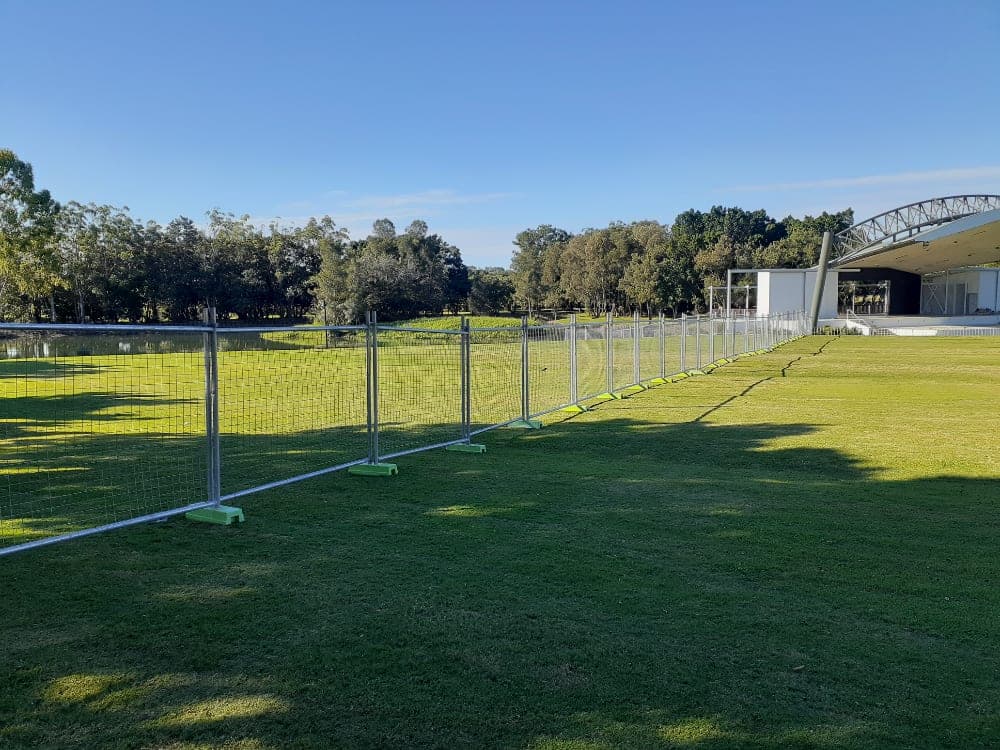
Event organisers rarely get fencing wrong by buying badly. They get it wrong by assigning the wrong type to the job: crowd barriers doing perimeter duty, mesh where picket belonged, nothing at all where the car park meets the crowd. The fix is a naming exercise. Every boundary at an event does one of four jobs; name the job, and the type follows.
Job one: keep people out (or in). That is mesh.
Ticket lines, licensed area boundaries, equipment compounds, overnight security: any boundary that must resist a person who wants to cross it needs actual fence, full height mesh, coupled and footed as a system. Where sightlines invite fence jumping, solid hoarding closes the view; where the corner is quiet and tempting, security height raises the price of trying. The full adversarial logic is in the festival security guide.
Job two: shape how people move. That is crowd barrier.
Queues, stage standoffs, walkway edges, split flows: crowd control barriers exist for boundaries that people willingly respect. They interlock into lines, reconfigure in minutes as the day changes shape, and manage crowds beautifully. What they do not do is stop anyone determined, which is why a crowd barrier perimeter is the most common event fencing mistake. People management, not property protection. The craft is covered in crowd control barrier hire.
Job three: define a space without fortifying it. That is picket.
VIP lawns, sponsor activations, dining areas, family zones: white picket fencing in heights from 0.8m to 1.2m draws a boundary that reads as an invitation with an edge. It photographs well, keeps sightlines open, and tells patrons "this area is organised" rather than "you are not welcome". Aesthetic zones fenced with mesh feel like holding pens; the reverse mistake, picket on a security boundary, is worse.
Job four: survive a vehicle. That is water barrier.
Car park edges, drop off loops, road frontages, anywhere wheels and feet share geography: the boundary needs mass. Water filled barriers are positioned empty and become heavy in place, with extensions where height matters too. No fence panel or crowd barrier substitutes here, because the failure mode is not a person pushing, it is a car drifting. The surrounding traffic kit, arrow boards, cones, is covered in event traffic safety.
The mixed reality
Real events combine all four. A regional show: mesh ticket line (job one), barrier queues at gates and arenas (job two), picket around the pavilion lawn (job three), water barriers where the car park field meets the walking route (job four). Sponsor banner mesh rides the mesh runs, with the bracing its wind load demands.
A five minute self test
Walk your site plan boundary by boundary and ask: is this line resisting, shaping, defining or surviving? Any line with two answers gets the stronger type. Any line with no answer probably should not be fenced at all, fence costs money and blocks flows, and the discipline cuts both ways.
Pricing the mix
Send the plan with a quote request, or get in touch. For the fuller planning sequence, the major event method and the 11 step guide take it from here.