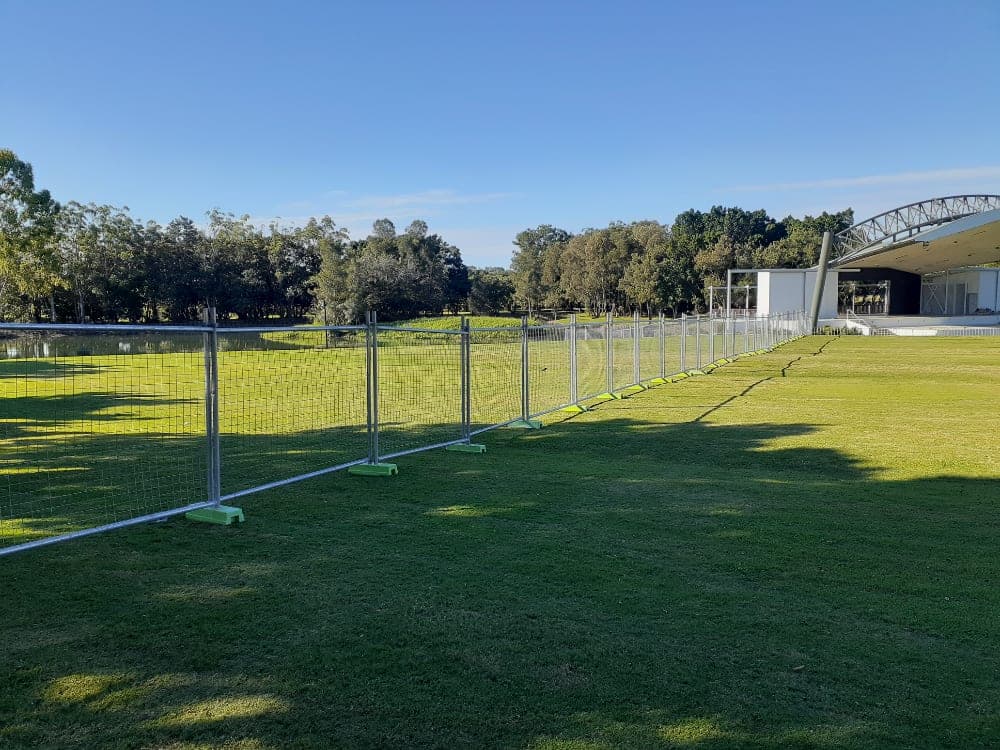
Stand at any event gate and watch what the crowd reads. Not the signage, the geometry. A barrier line curving toward an entrance says "queue here" in a language nobody needs translated. Barriers are the grammar of an event site, and organisers who use them fluently run calmer events with fewer staff.
The vocabulary
The unit is the orange crowd control barrier: 2.1 metres, waist height, interlocking, flat footed, high visibility. Interlock is the grammar's core rule, connected lines read as boundaries, scattered singles read as clutter, and a crowd treats them accordingly.
Queue arithmetic, the part everyone underestimates
A queue lane holds roughly two people per metre in comfort. A headline act letting in three thousand people through four lanes needs those lanes long, and the space for them measured off the site plan, not hoped for on the day. The gate itself processes people at a rate the queue must feed, not exceed: lanes that hold more than the gate clears per hour just relocate the crush.
Three rules keep gates civil:
- Lanes, not funnels. Wide crowds compressing into narrow gates is where distress starts. Parallel barrier lanes meter the flow before the throat.
- Transactions before the throat. Ticket offices and bag checks positioned so their pauses happen in lane, not in the gateway.
- An empty lane in reserve. Accessible access, staff movements, incident response: the spare lane pays for itself the first time it is needed.
Flows: keep opposing streams apart
Crowds moving in opposite directions through the same space shed speed and gain friction. Barrier lines that separate entry from exit, and cross traffic from main flow, remove the friction wholesale. The investment is modest, the effect on how an event feels is not.
Stage standoffs and dense crowd honesty
Barriers hold a gap between crowd and stage infrastructure for ordinary densities. A packed festival front of stage, thousands pressing forward, is a different physics problem needing engineered stage barrier and a safety plan to match. Knowing which event you are running is part of the safety case; the festival security guide covers where the line sits.
The reconfiguration discipline
The barrier plan is not one layout, it is a sequence: arrival mode, event mode, exit mode. Exit mode matters most, the full crowd leaves in a fraction of the arrival window, and the barrier geometry should open accordingly. Someone owns each change, with a time and a map. Barriers migrate at events, borrowed for a spill, moved for a vehicle, and unowned barriers never come back.
What barriers are not
Not a perimeter: ticket lines and licensed boundaries need real fence. Not vehicle protection: car park interfaces need water barriers with real mass. The type decision guide sorts all four jobs.
Counting and booking
Count lanes generously, add the reserve, and book against the events calendar, barrier demand peaks exactly when you need it. Request a quote with attendance and site plan, or get in touch.