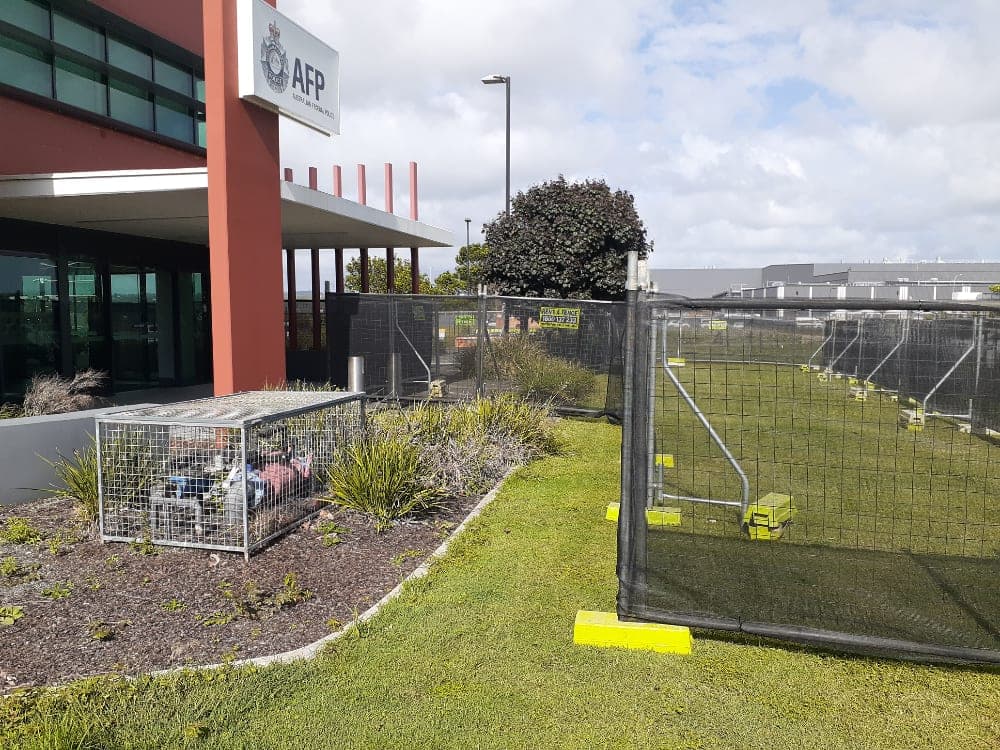
Temporary fencing is a national product governed by state rules. A builder working across the Queensland and New South Wales border runs the same panels under two different legal regimes, and the differences are exactly the kind that surface at the worst time: during an incident investigation or a council inspection.
This is a working map of what changes as you cross borders. It is general information rather than legal advice; the regulator in each state is the authority.
The layer that is nearly national: WHS duties
Most states and territories run the harmonised Work Health and Safety framework: Queensland, New South Wales, South Australia, Tasmania, Western Australia and the territories. The duty is the same in each: the person conducting the business must, so far as is reasonably practicable, keep workers and the public safe, and the site perimeter is a primary control for that duty.
Victoria is the exception. It operates its own Occupational Health and Safety Act 2004. The practical duty is similar, but the terminology, codes of practice and regulator, WorkSafe Victoria, differ. Documentation written for a harmonised state should be reviewed before being reused on a Victorian job.
The layer that is never national: councils
Anything on or over public land, footpaths, road reserves, nature strips, needs local government permission, and there are more than 500 local governments in Australia. The variation is genuine: application fees, insurance minimums, pedestrian management conditions, lighting requirements and processing times all differ, sometimes dramatically, between neighbouring councils.
The only reliable practice is to treat every new council area as unknown and check early, because permit lead time is frequently longer than equipment lead time.
Pool barriers: the sharpest state differences
Every state requires compliant barriers around pools, and the product standard, AS 1926.1, is common. The administration differs sharply:
- New South Wales runs a register and certification regime under the Swimming Pools Act 1992, with inspection obligations on sale and lease.
- Queensland regulates through the pool safety provisions of its building legislation, with its own inspector licensing.
- Victoria requires registration with the local council and periodic compliance certification.
- Other states each have their own inspection and certification arrangements.
What does not differ: standard temporary mesh is not a pool barrier anywhere. The dedicated pool panels and temporary pool gate are the compliant line. Our NSW pool fencing guide covers the strictest regime in detail.
Traffic and road interfaces
Work affecting a road runs under state road authority schemes, each with its own accreditation for traffic management design and implementation. The equipment, water barriers, cones, arrow boards, is consistent nationally; the paperwork and the people qualified to sign it are not.
The product standard underneath it all
AS 4687, the temporary fencing and hoardings standard, is national and applies wherever the fence stands. It is a big enough subject to deserve its own explainer: what AS 4687 actually covers.
A border crossing checklist
- Confirm which WHS regime applies, especially moving into or out of Victoria.
- Treat the council as new every time, and start the permit before booking equipment.
- If a pool is anywhere near the work, check the state's administration, not just the standard.
- For road interfaces, confirm the state scheme and who is accredited under it.
- Keep the equipment documentation with the site records in every state.
Working across borders?
Rentafence supplies compliant fencing and the documentation to back it in every state we operate. Request a quote or get in touch, and the FAQ covers the practical hire questions.