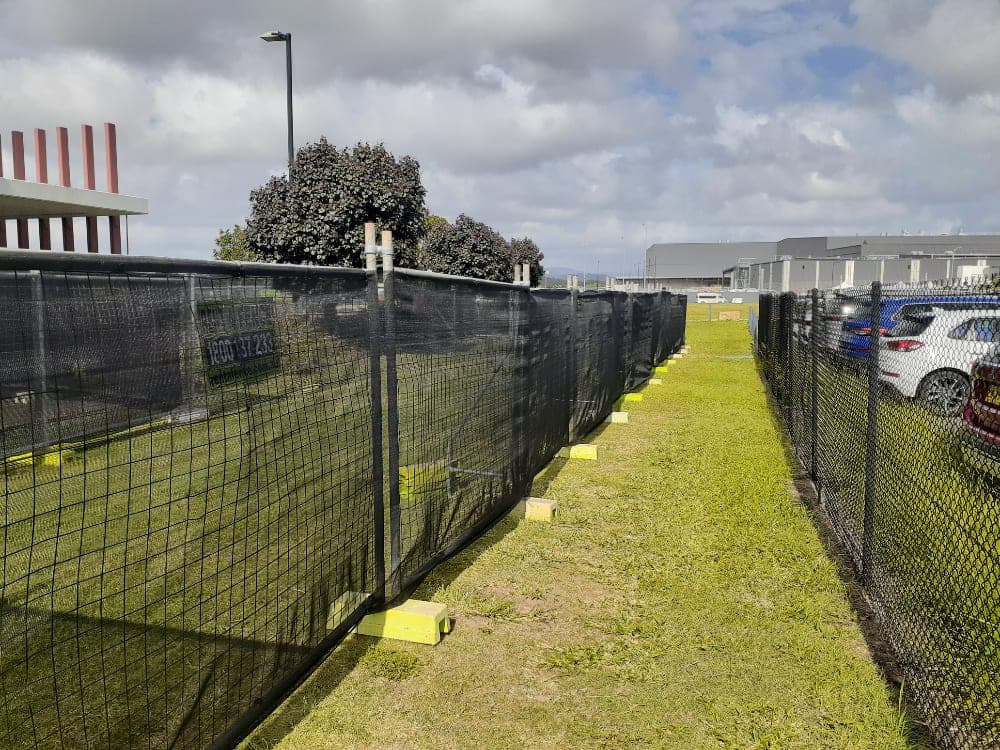
Every construction programme has a hidden dependency: the patience of the people next door. Councils grant working hours, but neighbours effectively administer them, through the complaints that trigger inspections, conditions and, at the bad end, restricted hours that reprice the whole job. Noise is the number one withdrawal from the goodwill account, and the noise reduction barrier is the cheapest deposit available.
The physics, usefully simplified
Sound leaves a site as energy, and an open mesh fence is acoustically transparent, the noise walks straight through. An acoustic barrier mounted on the fence adds mass and absorption at the boundary: some energy is absorbed, some reflected back toward the source, and the neighbour's side gets measurably less.
Two rules govern how much less:
- Source proximity wins. A barrier wrapped close around the noisy thing, the saw station, the generator, the compressor, outperforms the same panels strung along a distant boundary. Treat the source, not just the property line.
- Line of sight leaks. Sound diffracts over barriers, so anywhere a neighbour's window or balcony can see the work, height matters. A barrier they can see over is working at half rate.
What the site gets back
Hours kept and extended. Applications for early starts, Saturdays or out of hours work succeed far more often with demonstrated noise controls, and survive the first complaint far better.
A calmer public file. When a complaint does land, the inspector finds a site that visibly manages its noise. That changes the tone of every subsequent interaction with the council.
A better site inside. The same attenuation protecting the street protects the crew beside the plant, and makes normal conversation, and instruction hearing, possible on the pad.
Screening thrown in. An acoustic barrier is also a solid visual barrier: dust is better contained, the work is screened, and the two other classic complaint streams shrink alongside the noise.
The mandatory wind conversation
Acoustic panels turn mesh into a solid surface, and solid surfaces sail. This is the same physics that fells banner mesh runs, at higher mass. Bracing and ballast are engineered with the barrier from day one, specified per the AS 4687 system logic, never retrofitted after the run leans. Exposed boundaries and corners get particular attention in the design.
Where barriers earn fastest
- Residential boundaries, which is most urban work
- Out of hours programmes, where the permission is conditional on control
- Long jobs, where goodwill depletes on a schedule of its own
- Event stages and generator compounds backing onto homes, the festival perimeter doing double duty
Specifying a quieter site
Site plan, noisiest activities, nearest windows: three inputs and the barrier extent, height and bracing design follow. Request a quote or get in touch. The wider perimeter picture is in construction site fencing.