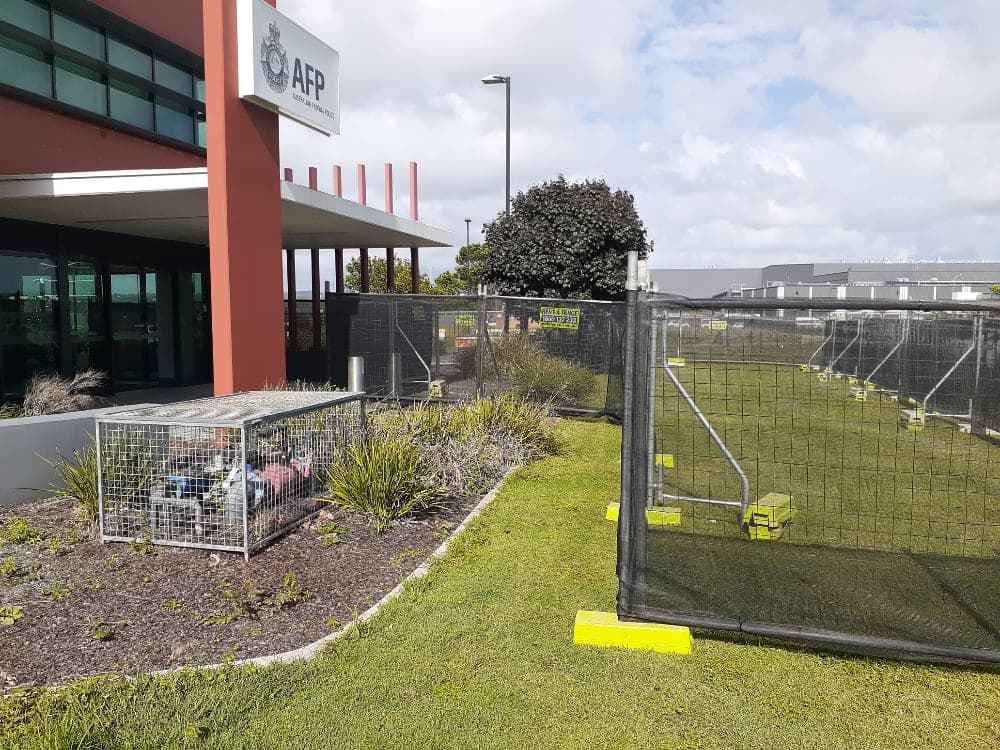
Every construction site borrows its surroundings. The street takes the deliveries, the footpath takes the detour, the neighbours take the noise. The perimeter fence is the promise made in return: whatever happens in here stays in here. Keeping that promise is a design problem, and this is how it gets solved.
What the fence is actually protecting against
Work health and safety law puts the duty plainly: the public must be protected from the work, so far as is reasonably practicable. Around a construction site that translates to four specific exposures:
- Entry: the shortcut taker, the curious child, the scrap collector. All predictable, all foreseeable in the legal sense.
- Falling and flying material: the exclusion distance under loads and beside demolition.
- Open hazards after hours: excavations, penetrations, stored chemicals, standing water. A site is at its most dangerous when no one is there to shout.
- Vehicle interfaces: everywhere site traffic and public traffic share an edge.
Matching equipment to exposure
One fence type does not cover four exposures. The Rentafence approach is to walk the boundary and assign each stretch its product:
- Mesh panels for the general perimeter: continuous, visible, and engineered as a system of panel, foot, coupler and bracing under AS 4687
- Hoarding where sightlines, dust or street presence demand a solid face
- Water barriers where the edge needs mass because vehicles are part of the picture
- Self closing gates where access discipline cannot depend on the last person through
- Noise barriers on residential boundaries, covered in quieter worksites
- Pool panels the moment any water feature sits inside the boundary, because site mesh is not a pool barrier
The four ways perimeters fail
Perimeter failures are boring and repetitive, which is what makes them preventable.
- Wind on a sheeted run. Shade cloth and banner mesh turn mesh into sail. The bracing and ballast must be specified with the sheeting.
- The propped gate. A gate that inconveniences the crew gets wedged open by Wednesday. Gates belong where traffic actually flows.
- The junction gap. Fences fail where they meet buildings, neighbours and services, the stretches nobody owned.
- Drift. Opened for a delivery, never fully closed. On long jobs, drift beats storms as the top cause of a compromised line.
The countermeasure to all four is the same: someone owns the perimeter, walks it weekly, and walks it again after weather and after every delivery heavy week.
Installed as a system
Because the fence performs as an assembled system, installation quality is part of compliance, not a convenience. Rentafence fencing arrives with installation by our crews: line set out, feet and couplers placed, bracing fitted to the specification, gates hung and latching. The full process runs from quote to handover.
Scoping your site
Measure the boundary with the calculator, then request a quote with the site's specifics: sheeting plans, exposed corners, road edges, anything with water in it. The specialist stretches cost less to include at the start than to retrofit after the first incident report.
Related reading: fencing in modern construction and the hire FAQ.